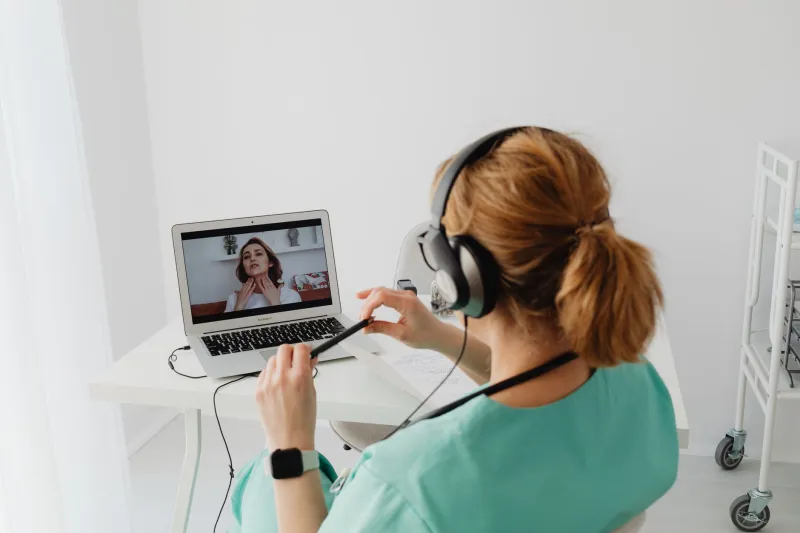
Too Many Doors, Too Little Direction: How Round-the-Clock Healthcare Access Is Leaving Americans More Confused Than Confident

For most of human history, access to medical guidance was constrained by time, geography, and availability. You called your doctor during office hours, waited in a waiting room, and trusted a single professional to interpret your symptoms. The limitations were frustrating, but they also imposed a kind of clarity: there was one path forward, and you took it.
Today, that scarcity has been replaced by its opposite. Americans can consult a licensed provider at 2 AM on a Tuesday, cross-reference their symptoms against thousands of peer-reviewed studies, read patient forums populated by people who have experienced nearly identical complaints, and receive a prescription — all before sunrise. By any objective measure, this represents an extraordinary expansion of patient empowerment.
And yet, for a growing number of Americans, the experience of navigating modern healthcare feels less like empowerment and more like standing at the center of a maze with too many exits.
The Psychology of Too Many Choices
Decision paralysis is not a character flaw. It is a well-documented psychological response to choice overload — a phenomenon studied extensively since psychologist Barry Schwartz introduced the concept of the "paradox of choice" in the early 2000s. When the number of available options exceeds a person's cognitive bandwidth, the result is often not better decision-making but rather anxiety, avoidance, and persistent second-guessing.
Healthcare, it turns out, is a near-perfect environment for this effect to thrive.
Consider a patient who wakes at midnight with a dull ache in their chest. In 1995, their options were limited: call an after-hours nurse line, drive to the emergency room, or wait until morning. The decision, while stressful, was structurally simple.
Today, that same patient can open a telehealth app, search their symptoms across a dozen authoritative medical websites, post a question to a patient community, review their own wearable health data, consult an AI symptom checker, and schedule a same-night video visit — all within fifteen minutes. Each of these steps produces information. None of them, in isolation, produces clarity. And the accumulation of conflicting signals can leave the patient more distressed than they were when they first opened their eyes.
When Access Becomes Its Own Burden
Researchers and clinicians have begun to identify a pattern they sometimes call "medical decision fatigue" — a state in which patients who have been exposed to abundant healthcare information become less capable of making confident, grounded decisions about their own care. The symptoms of this condition are subtle but consequential.
Patients in this state tend to over-investigate minor complaints, cycling through multiple providers in search of a diagnosis that feels conclusive rather than accepting reasonable clinical reassurance. They may delay acting on genuinely urgent symptoms because they are waiting for certainty that never arrives. They frequently experience heightened health anxiety not despite their access to information, but because of it.
The 24/7 availability of telehealth resources, while genuinely valuable in the right circumstances, can inadvertently reinforce this cycle. When a provider is always available, the implicit message is that consultation is always warranted. The concept of watchful waiting — one of the most clinically sound and time-honored approaches to minor symptoms — becomes psychologically difficult to sustain when an alternative is perpetually within reach.
The Reassurance Trap
One of the more counterintuitive findings in health psychology is that seeking medical reassurance for minor symptoms often makes anxiety worse rather than better. Each consultation that ends with "everything looks fine" provides temporary relief, but it also reinforces the belief that a consultation was necessary. Over time, patients begin to require more frequent reassurance to achieve the same reduction in anxiety — a pattern that bears an uncomfortable resemblance to tolerance in substance dependence.
This is not an argument against using telehealth resources. It is an argument for using them with intention.
The most effective patients — those who report both lower health anxiety and better long-term outcomes — tend to approach 24/7 healthcare access as a targeted tool rather than a default response to uncertainty. They have, whether consciously or through experience, developed an internal triage system that helps them distinguish between symptoms that genuinely warrant immediate consultation and discomfort that can be safely monitored at home.
Building a Sustainable Framework
Developing that internal triage system is not as complicated as it might sound, but it does require deliberate effort. The following principles offer a starting point.
Establish a baseline relationship with a primary care provider. This remains the single most effective buffer against decision paralysis. A physician who knows your health history, your anxiety patterns, and your typical symptom profile can provide guidance that no anonymous telehealth encounter can replicate. Think of 24/7 resources as supplements to that relationship, not replacements for it.
Create a personal symptom threshold list. Work with your primary care provider to identify the specific symptoms that, in your individual health context, warrant immediate contact versus watchful waiting. Having this list written down and accessible at 2 AM removes the need to make a high-stakes decision from scratch under stress.
Impose a brief waiting period for non-emergency concerns. For symptoms that are uncomfortable but not severe — and that do not include chest pain, difficulty breathing, neurological changes, or signs of serious infection — a structured waiting period of thirty to sixty minutes can interrupt the impulse to seek immediate reassurance and allow the body's own regulatory processes to resolve minor complaints.
Treat information-gathering as a finite task. If you choose to research a symptom online, set a time limit and consult only two or three authoritative sources. The marginal value of each additional source diminishes rapidly while anxiety compounds.
Recognize that uncertainty is a feature, not a failure. Medicine does not always yield certainty, and the pursuit of a definitive answer to every symptom is not a realistic or healthy goal. Learning to tolerate a degree of diagnostic ambiguity is, paradoxically, one of the most health-promoting skills an American patient can develop.
When 24/7 Access Truly Shines
None of this is to suggest that round-the-clock healthcare access is anything other than a genuine advancement. For patients managing chronic conditions who experience unexpected symptom changes at night, for parents navigating a child's sudden fever at 3 AM, for individuals in rural communities without nearby urgent care facilities, and for anyone experiencing symptoms that cross objective thresholds for urgency, immediate access to a licensed provider is not a luxury — it is a lifeline.
The goal is not to use these resources less. The goal is to use them wisely — reserving them for the moments when they deliver their greatest value, and cultivating the confidence to manage the moments when they do not.
At Healthcare 24Hrs, we believe that true patient empowerment is not measured by how often you access care. It is measured by how clearly you understand when to reach out, when to wait, and when to trust the body's remarkable capacity to resolve its own minor disruptions. That kind of clarity is available to every American — but it requires building it deliberately, one informed decision at a time.