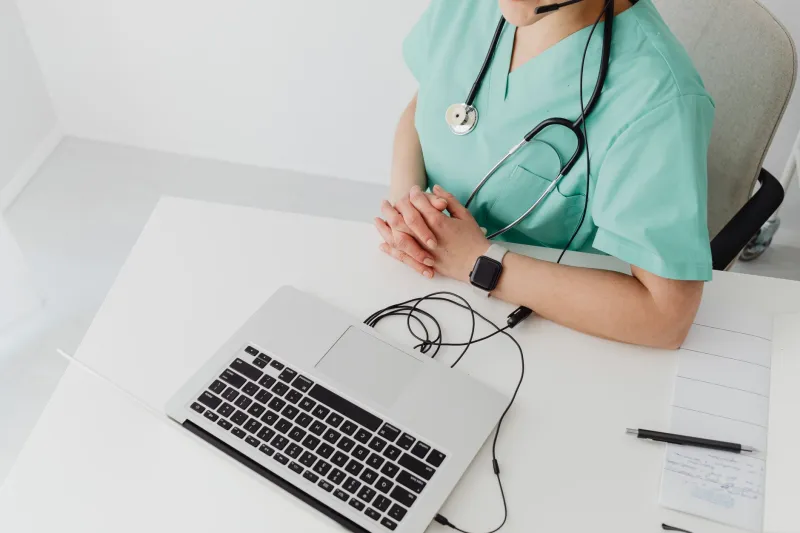
When Daylight Erases the Evidence: How Daytime Telehealth Appointments Are Leaving Nighttime Symptoms Undiagnosed
Photo: Shixart1985, CC BY 2.0, via Wikimedia Commons
It begins the same way for thousands of Americans every week. A troubling symptom surfaces in the middle of the night — chest tightness, a racing heart, a headache that feels unlike any other. By 8 AM, it has faded. By the time a telehealth appointment is scheduled and the provider appears on screen, the body has moved on. The patient struggles to describe what happened. The provider, working from what they can observe in real time, finds little to act on. The visit concludes. The symptom returns the next night.
This cycle, quiet and frustratingly common, represents one of the more underappreciated diagnostic gaps in modern American healthcare. Telehealth has transformed access to medical guidance — offering round-the-clock availability, convenience, and immediacy that traditional clinic visits cannot always match. But convenience has a shadow side: when patients schedule appointments at whatever hour feels manageable rather than when their symptoms are actually active, the clinical picture can be incomplete in ways that matter enormously.
Why the Body Does Not Keep Business Hours
Human physiology operates on a 24-hour internal clock known as the circadian rhythm, and that clock governs far more than sleep and wakefulness. Blood pressure, cortisol levels, airway resistance, inflammatory markers, and cardiac electrical activity all fluctuate in predictable patterns across the day. What this means clinically is that certain conditions are not simply "present" or "absent" — they are time-dependent expressions of underlying dysfunction.
Nocturnal hypertension is one of the clearest examples. A patient whose blood pressure appears normal during a mid-morning telehealth visit may experience dangerous pressure elevations between midnight and 4 AM — a pattern associated with significantly elevated cardiovascular risk. Without ambulatory blood pressure monitoring or a provider who specifically asks about nighttime readings, this finding can remain invisible for years.
Sleep apnea presents a similar challenge. A patient may describe fatigue, morning headaches, and difficulty concentrating. A daytime provider, observing a fully alert individual with normal oxygen saturation on a video call, may not immediately connect these complaints to an airway that partially collapses dozens of times per hour during sleep. The symptom — apnea — is physically unreachable during a 2 PM appointment.
Nocturnal asthma, acid reflux that worsens in the supine position, restless legs syndrome, cluster headaches that reliably strike between 1 AM and 3 AM, and certain cardiac arrhythmias that emerge during sleep are all conditions whose defining characteristics vanish with daylight. For patients with these conditions, the daytime telehealth visit is not a diagnostic tool — it is a conversation about a body the provider has never actually seen.
The Frustration Behind the Missed Window
Patients who live with undiagnosed nocturnal conditions often describe a particular kind of medical exhaustion: the sense that they are credible witnesses to their own suffering but cannot produce the evidence their providers need. They arrive at appointments having experienced something real and alarming, only to find that the body has cleaned up after itself.
Consider the experience of a middle-aged woman in the Midwest who spent nearly eight months reporting nighttime heart palpitations to her primary care provider. Daytime EKGs were normal. A telehealth follow-up, scheduled at her employer's lunch break, revealed nothing unusual. It was only after she began logging her heart rate manually at 2 AM using a consumer smartwatch — and brought three weeks of timestamped data to a subsequent appointment — that a paroxysmal supraventricular tachycardia was eventually identified and treated.
Her case is not exceptional. It is representative of what happens when the timing of symptom evaluation is misaligned with the timing of symptom occurrence.
What Providers Cannot See Without Help
Telehealth providers are skilled clinicians working within the constraints of the medium. What they observe during a virtual visit is a snapshot — a single frame from a film that runs continuously. When that snapshot is taken at the wrong moment, it may capture nothing of diagnostic value.
This is not a failure of telehealth as a platform. It is a structural limitation that patients and providers alike need to understand. A telehealth visit at 2 PM with a patient reporting nighttime symptoms is, in some respects, analogous to asking a meteorologist to assess last night's storm by looking at today's clear sky. The conditions are simply no longer present.
What providers can work with, however, is documentation. Objective, timestamped, detailed records of symptoms as they occur shift the diagnostic conversation from recall to evidence.
Strategies for Capturing What the Night Reveals
For patients whose symptoms are time-specific, proactive documentation is not optional — it is essential. The following approaches can meaningfully improve the quality of information a provider receives, regardless of when the appointment takes place.
Maintain a timestamped symptom journal. When a symptom wakes you or intensifies after dark, note the exact time, the nature and severity of the symptom, any associated factors (body position, recent meals, activity level), and how long it persisted. Apps designed for health tracking can simplify this process and make the log easy to share.
Use consumer-grade monitoring devices strategically. Wearables that track heart rate, blood oxygen saturation, and sleep stages have become remarkably accurate. If you suspect a nocturnal condition, wearing a device during sleep and reviewing the data the following morning can surface patterns that neither you nor your provider would otherwise detect.
Request at-home diagnostic tools when appropriate. Home blood pressure monitors that log readings with timestamps allow patients to document nocturnal hypertension without a clinic visit. At-home sleep studies, increasingly available through telehealth platforms and covered by many insurance plans, can identify sleep-disordered breathing without requiring an overnight stay in a sleep laboratory.
Ask for a nighttime or early-morning telehealth appointment. Many telehealth platforms operating around the clock — including services accessible through Healthcare 24Hrs — offer appointments at hours that align with when symptoms are actually active. Connecting with a provider at 2 AM, while a symptom is present, can provide a real-time clinical picture that no amount of retrospective description can fully replicate.
Communicate the timing explicitly. When speaking with any provider, make the time-dependence of your symptoms a central part of the conversation. Phrases such as "this only happens between midnight and 3 AM" or "I have never experienced this during daylight hours" direct clinical attention toward the possibility of a circadian or sleep-related mechanism.
The Case for Aligning Evaluation With Experience
The promise of 24-hour healthcare access is not simply about convenience — it is about accuracy. A platform that connects patients with licensed providers at any hour of the day or night has the potential to close the diagnostic gap that daytime-only medicine cannot address. But that potential is realized only when patients understand that the timing of their appointment is itself a clinical variable.
If your body is telling you something after midnight, the most useful thing you can do — beyond seeking care — is to make sure that story is being heard at the right moment, with the right evidence, by a provider who has the opportunity to witness what daylight tends to erase.
Your symptoms do not follow a schedule. Your healthcare, wherever possible, should not either.